
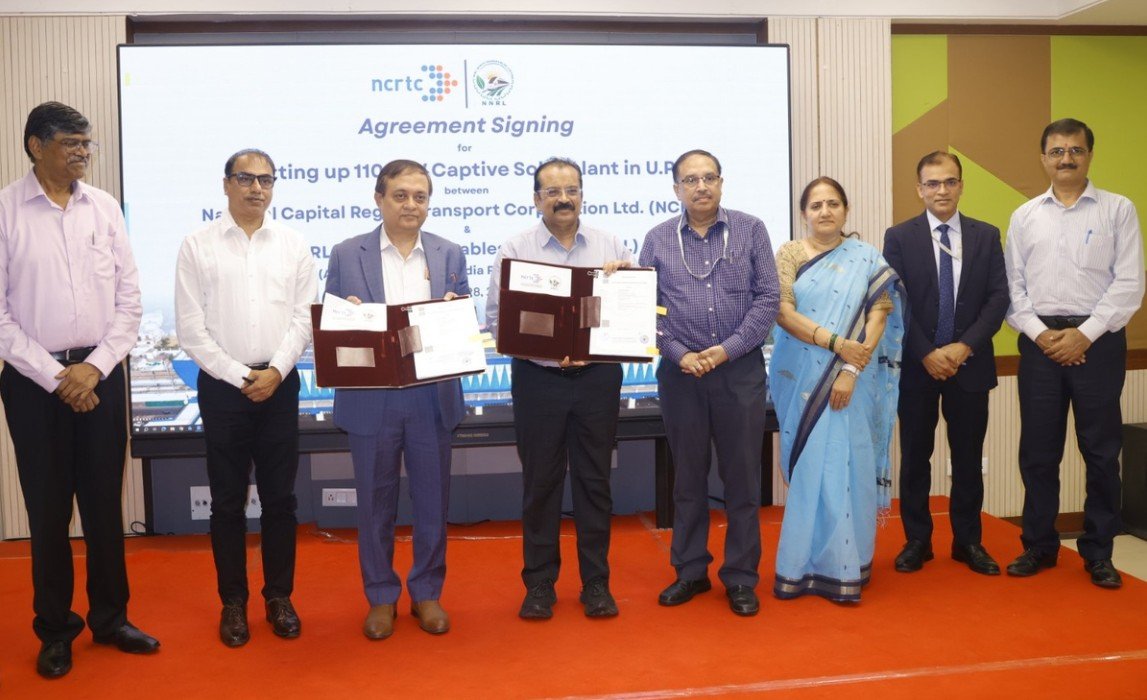
The National Capital Region Transport Corporation (NCRTC) has taken a major step toward greening India’s fastest regional rail system, signing a long-term power purchase agreement for a 110 MW solar plant in Uttar Pradesh. Once operational, the plant is expected to supply nearly 60 per cent of the electricity needed to run the entire Delhi-Meerut Namo Bharat corridor.
A Rs 450 Crore Solar Push in Jaulan
The solar facility will come up at Jaulan in Uttar Pradesh, with an estimated investment of around Rs 450 crore. Construction and commissioning are expected to be completed within 24 months, after which the plant will begin feeding power into the Uttar Pradesh grid. From there, electricity will be distributed to NCRTC’s substations across both Uttar Pradesh and Delhi, powering trains, stations, and associated infrastructure along the corridor.
What makes this deal particularly significant is its structure: NCRTC has locked in a fixed tariff for 25 years. That kind of long-term price certainty is rare in India’s power sector, where electricity costs for large infrastructure operators can fluctuate considerably depending on fuel prices, grid conditions, and market dynamics. By fixing the tariff for a quarter of a century, NCRTC is effectively insulating a major chunk of its future power expenses from that volatility.
Why This Matters for Namo Bharat’s Bottom Line
Power isn’t a minor line item for a rail system like Namo Bharat; it’s one of the highest ongoing costs. Electricity currently accounts for around 30-35 per cent of the corridor’s total operational expenditure, making it one of the largest components of day-to-day service.
With the new solar plant coming online, NCRTC expects annual electricity costs to fall by about 25 per cent. For a system that’s still scaling up ridership and expanding services, a cost reduction of that magnitude could meaningfully improve the corridor’s long-term financial sustainability, potentially freeing up resources for service expansion, maintenance, or fare stability.
A Big Win for the Environment Too
Beyond the financial upside, the project carries a substantial environmental payoff. NCRTC projects that the solar plant will help cut carbon dioxide emissions by around 1.77 lakh tonnes every year a significant reduction for a transit system that’s already positioned as a low-emission alternative to road travel across the National Capital Region.
The shift to solar is also expected to lower emissions of other pollutants, including nitrogen oxides and sulphur dioxide, both of which are major contributors to air quality problems in the Delhi-NCR region. Given how frequently the capital and its surrounding areas battle poor air quality, particularly during winter months, a large-scale renewable energy commitment tied to a mass transit system adds another data point to the region’s broader clean-energy transition.
The Partners Behind the Project
The power purchase agreement was signed between NCRTC and NIRL NCRTC Renewables Ltd (NNRL), a joint venture formed specifically for renewable energy initiatives tied to the corridor. NNRL itself is a partnership between NCRTC and NIRL, which is a wholly owned subsidiary of Neyveli Lignite Corporation, a state-run energy company with deep experience in large-scale power generation projects.
This structure allows NCRTC to tap into specialized renewable energy expertise while keeping the arrangement closely tied to its own operational needs, rather than relying solely on open-market power purchases.
Growing Ridership Adds Urgency
The timing of this solar deal lines up with a broader growth story for the Namo Bharat corridor. The full Delhi-Meerut route was commissioned in February, and ridership has been climbing steadily since. NCRTC now says the system carries around one lakh passengers every day, with cumulative journeys on the corridor having crossed four crore.
As more commuters shift to the corridor for their daily travel between Delhi and Meerut, the pressure on operational infrastructure, including power supply, naturally increases. Locking in a large, stable, and increasingly cost-effective renewable energy source now positions NCRTC to support that growing demand without being as exposed to rising conventional power costs down the line.
The Bigger Picture
Taken together, the solar agreement reflects a broader trend among Indian infrastructure operators: pairing large-scale public transit expansion with renewable energy investment from the outset, rather than retrofitting sustainability measures later. For Namo Bharat, a system still in its early growth phase, this move could help ensure that both its finances and its environmental footprint stay on a stronger footing as ridership continues to climb in the years ahead.
