
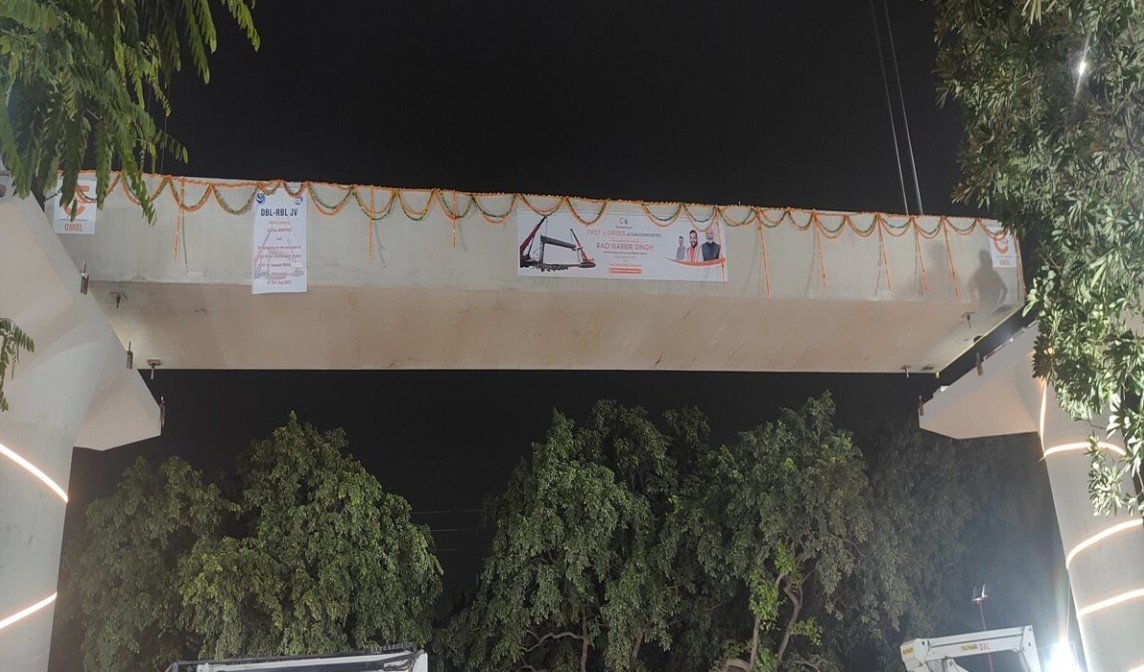
The Gurgaon Metro project has crossed a significant construction milestone, with the first of its massive 160-tonne U-girders now installed near Cyber Park. The launch marks the start of a critical new phase for the project, one that will visibly reshape the city’s skyline over the coming months as hundreds more of these giant structures go up.
A Heavyweight First Step
The inaugural girder was carefully positioned between piers P2/26 and P2/27, a delicate operation given the sheer scale of the component. Each U-girder measures about 28 metres in length and 5 metres in width, and weighs in at roughly 160 tonnes, comparable to the weight of more than 100 mid-sized cars combined.
Inside each structure is nearly 16 tonnes of steel reinforcement and around 60 cubic metres of high-strength M-60 grade concrete, engineering choices meant to ensure the girders can safely bear the load of metro trains for decades. This is only the beginning: more than 1,600 such U-girders are expected to be installed along the length of the corridor as construction progresses.
Haryana’s Industry and Commerce Minister Rao Narbir Singh was present to mark the occasion, underlining the state government’s attention to the project as it moves from planning into visible, on-ground construction.
How the Girders Are Installed
Installing a structure this large isn’t as simple as lowering it into place during the day. Gurgaon Metro Rail Limited (GMRL), the agency overseeing the project, plans to launch the girders in pairs and largely during night-time hours, when road traffic is lighter, and disruption to daily city life can be minimised.
The process itself is a logistical feat. Each precast girder has to be transported through busy city roads on specialised trailers before being lifted and positioned with millimetre-level accuracy between piers, using heavy-duty cranes. Given the scale and weight involved, every installation requires careful planning, traffic coordination, and skilled crane operation to ensure the girders sit exactly where the alignment demands.
Where the Project Stands
Overall, civil works on Phase 1 of the Gurgaon Metro project are now around 32 per cent complete. Looking at the project as a whole, cumulative progress has crossed the 10 per cent mark, a meaningful jump from where things stood just months ago, though there’s still a long way to go before trains start running.
This update comes at a time when the pace of construction has faced public scrutiny. Prime Minister Narendra Modi had recently urged the Haryana government to speed up execution on the project, reflecting concerns that timelines were slipping. In response, GMRL has pointed to recent improvements, saying that progress has picked up meaningfully since the organisation became fully operational and able to run day-to-day execution independently.
What’s Next: Phase 2 on the Horizon
Even as Phase 1 construction ramps up, planning for the next stage of the network is already underway. GMRL is currently preparing tender documents for Phase 2 of the project and hopes to invite bids by September, signalling that the agency wants to keep momentum going rather than wait for Phase 1 to fully wrap up before starting the next round of groundwork.
Officials have expressed confidence that, despite the earlier delays that drew attention from the top levels of government, Phase 1 remains on track to be completed by its 2028 target. The successful installation of the first U-girder is being seen internally as proof that execution capacity is now in place to deliver on that timeline, though sustaining the pace across all 1,600-plus girders, along with the rest of the civil, systems, and track work, will be the real test in the months ahead.
Why It Matters for Gurgaon
For residents and commuters in Gurgaon, a city long associated with traffic congestion despite being one of India’s major corporate hubs, the metro expansion represents a much-needed alternative to road travel. Each girder installed brings the city one step closer to a wider, more connected rapid transit network one that planners hope will ease pressure on roads around key business districts like Cyber Park and beyond.
With construction now visibly accelerating and a second phase already in the pipeline, the coming months will be crucial in determining whether Gurgaon Metro can maintain this momentum and meet its 2028 completion goal.
