
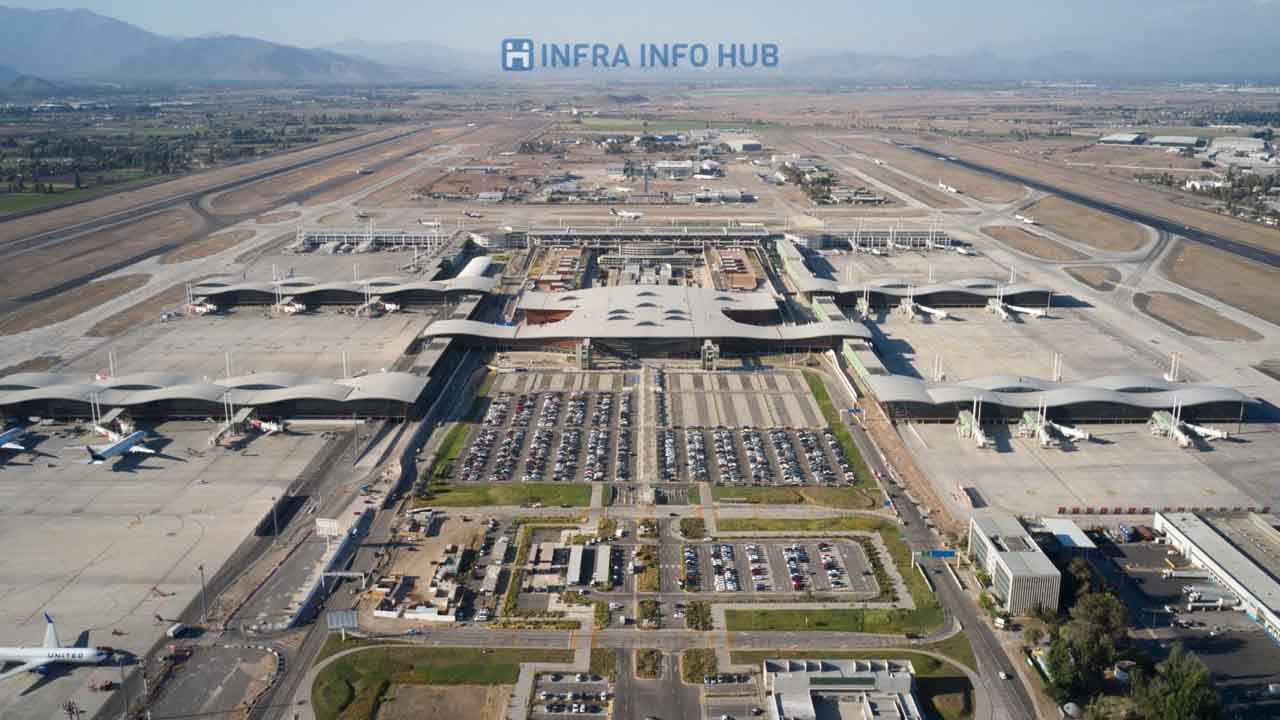
Chile has taken a major step toward reshaping its long-term aviation future, as five international and regional firms have submitted bids to design a large-scale expansion of Arturo Merino Benítez International Airport, the country’s principal air gateway. The design tender, launched by Chile’s Ministry of Public Works, marks the beginning of an ambitious plan to nearly double the airport’s footprint and prepare it for decades of passenger and cargo growth.
The bidding firms include Arcadis Chile, FAIC, IDOM-Vidal, Ingeniería Cuatro-AYESA, and Wood Ingeniería y Consultoría Chile. Each consortium brings extensive experience in airport master planning, aviation engineering, and large transport infrastructure projects, underscoring the scale and technical complexity of the expansion programme.
A Long-Term Vision for Santiago Airport
The design contract is intended to serve as the technical foundation for a comprehensive transformation of Santiago’s airport infrastructure. Authorities are planning for demand well beyond current capacity, with projections indicating a sharp rise in international travel, domestic connectivity, and air cargo volumes over the next two decades.
According to project documentation, the expansion vision includes a third passenger terminal, a third runway, and significant enhancements to cargo and logistics facilities. Once fully developed, the airport could handle up to 84 million passengers per year, compared with current levels that are already nearing saturation during peak periods. Aircraft movements are projected to rise to around 125 operations per hour, positioning Santiago among the busiest hubs in Latin America.
Expansion Footprint and Infrastructure Scope
The proposed development would expand the airport’s total area to more than 2,300 hectares, almost doubling its existing size. Over one million square metres of new terminal space may be constructed across multiple phases, allowing capacity to be added gradually as demand increases.
Beyond terminals and runways, the design scope also covers new access roads, internal transport systems, aircraft maintenance zones, civil aviation facilities, and operational support areas. Planners are also expected to integrate green spaces and buffer zones, improving environmental compatibility with surrounding urban areas.
Five-Year Design Programme
The consultancy contract is planned to run for approximately five years. During this period, the selected firm will prepare the basic and reference designs required for future construction tenders. This phase will define layouts, technical standards, phasing strategies, and cost frameworks, enabling the government to move efficiently into detailed engineering and land acquisition.
Construction is not expected to begin immediately. Current timelines suggest that major building works could start in the mid-2030s, once design, approvals, and preparatory processes are complete. This staged approach reflects the scale of the project and the need to maintain uninterrupted airport operations.
Sustainability requirements are central to the design competition. Chile has set clear expectations that the expanded airport must align with long-term climate and energy goals. Proposed designs are required to incorporate energy-efficient systems, renewable energy generation, advanced water management, and low-carbon construction strategies.
Future readiness is another key theme. The airport is expected to be designed to accommodate emerging technologies, including sustainable aviation fuels, electromobility, and potential green hydrogen infrastructure. Circular economy principles, waste reduction, and resilience to climate and seismic risks are also embedded in the project criteria.
As Chile’s main international hub, Santiago’s airport plays a critical role in tourism, trade, and national connectivity. The planned expansion is seen as essential to maintaining competitiveness in global air networks and supporting economic growth linked to exports, business travel, and regional integration.
With five firms now competing for the design mandate, the project has entered a decisive phase. The outcome will shape not only the physical form of Santiago’s airport, but also Chile’s position in international aviation for decades to come.
