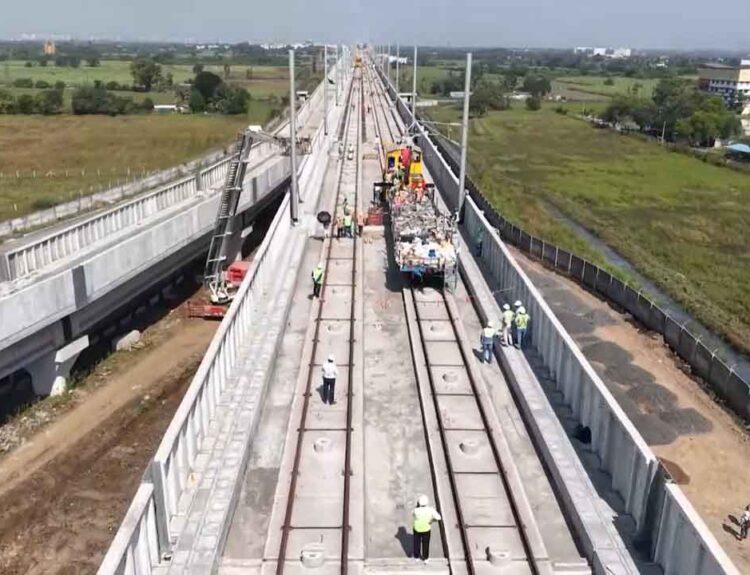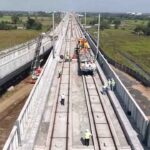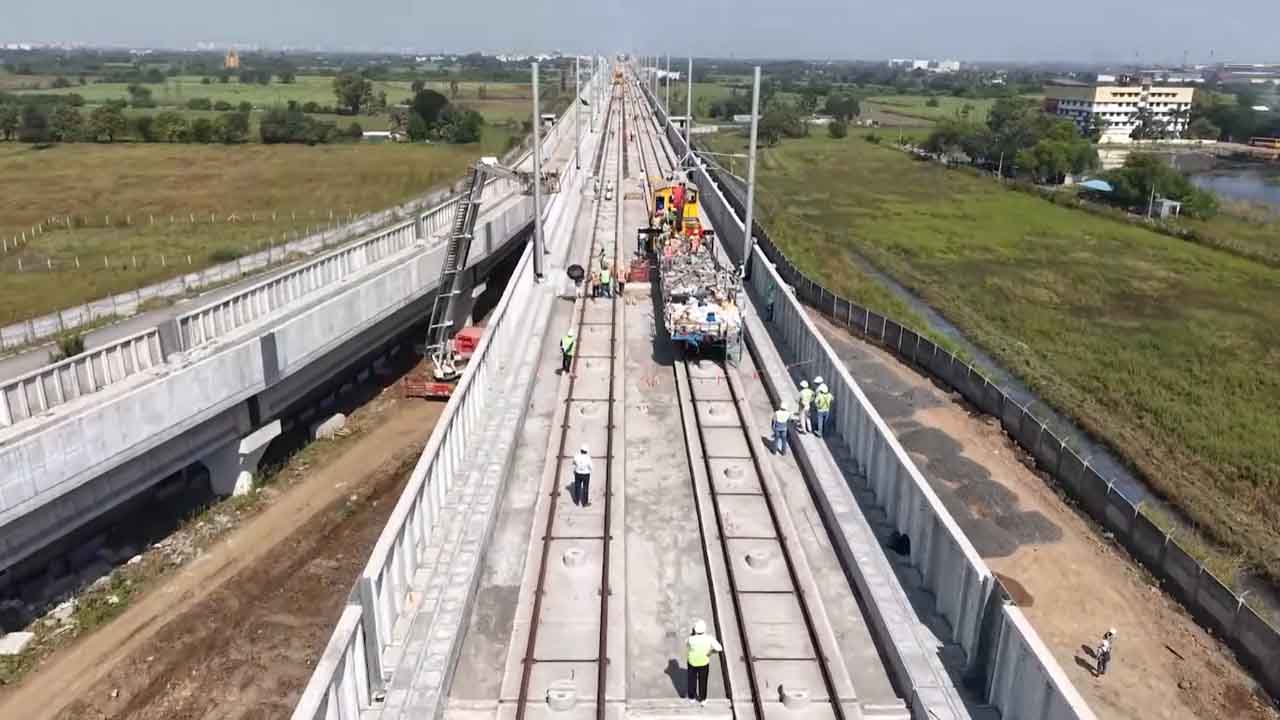
The Mumbai–Ahmedabad High-Speed Rail (MAHSR) corridor, India’s first bullet train project, has entered a key implementation stage with overhead electrification works progressing on the alignment, Railway Minister Ashwini Vaishnaw said on Monday (19 January). Sharing an update on social media, the minister posted images of the installation of Overhead Electrification (OHE) masts, calling it another “Make in India” milestone for the ambitious high-speed rail programme.
The installation of OHE masts is a crucial component of the corridor’s traction system. These structures will ultimately support the overhead power supply required for high-speed operations, enabling trains to draw electricity safely and consistently at speeds expected to reach up to 320 kmph on the 508-km route.
Table of Contents
OHE masts: backbone of the bullet train’s power system
According to official information and recent reporting, the bullet train corridor is planned to use a 2×25 kV overhead traction electrification system, a standard configuration for modern high-speed rail networks designed to provide stable power over long distances with reduced transmission losses. The masts being installed along the route act as the physical framework for the entire electrification chain, supporting overhead wires, fittings, earthing arrangements, and other accessories that feed traction power to trains.
A large share of mast installation work is taking place along elevated viaduct stretches, where the masts must be mounted at significant heights and aligned to precise engineering tolerances. Reports indicate that more than 20,000 OHE masts, each ranging roughly from 9.5 metres to 14.5 metres in height, are planned to be installed along the corridor.
Railway officials have described this stage as essential for shifting the corridor from civil construction milestones to systems readiness, bringing the project closer to trials and operations once track and station packages also reach completion.
India’s first bullet train project: route and stations
The MAHSR corridor will connect Maharashtra and Gujarat, running between Mumbai and Ahmedabad with a total of 12 stations: Mumbai, Thane, Virar, Boisar, Vapi, Bilimora, Surat, Bharuch, Vadodara, Anand, Ahmedabad, and Sabarmati. The corridor is being developed and implemented by the National High Speed Rail Corporation Limited (NHSRCL).
The line is expected to feature a mix of elevated sections, tunnels, and complex urban interfacing, including a challenging stretch near Mumbai that requires intricate engineering solutions. Electrification progress, therefore, is being watched closely as a signal of broader project momentum across packages.
“Make in India” push in high-speed rail systems
Vaishnaw’s post also emphasised the “Make in India” aspect of the project. While India is adopting proven high-speed rail technologies, the execution relies on a major domestic supply chain in civil works, steel structures, fabrication, and electrification hardware. The OHE mast installation phase particularly showcases Indian manufacturing and installation capability at scale, involving precision components, foundation works on viaducts, and stringent safety standards for high-altitude construction zones.
Recent official communication has underlined that these masts are not a symbolic addition but a functional prerequisite for electrified high-speed movement, influencing safety, reliability, and operational efficiency.
Timeline focus: phased commissioning likely
While the complete corridor commissioning remains a major national milestone, recent statements in the public domain have also hinted at phased operational targets where select stretches could become operational earlier than the full Mumbai–Ahmedabad run. A Times of India report earlier this month quoted the railway minister indicating that the first bullet train service could be ready around 15 August 2027, depending on completion progress and system integration readiness.
With electrification structures now being installed, the corridor’s progress is visibly moving beyond civil foundations toward core rail systems, an important transition stage for any high-speed rail project.
For commuters and industry observers, the pace of OHE mast installation will be an indicator of how quickly the project can move toward track electrification, systems testing, and eventual trial runs, each a necessary step before India’s first bullet train becomes a reality.