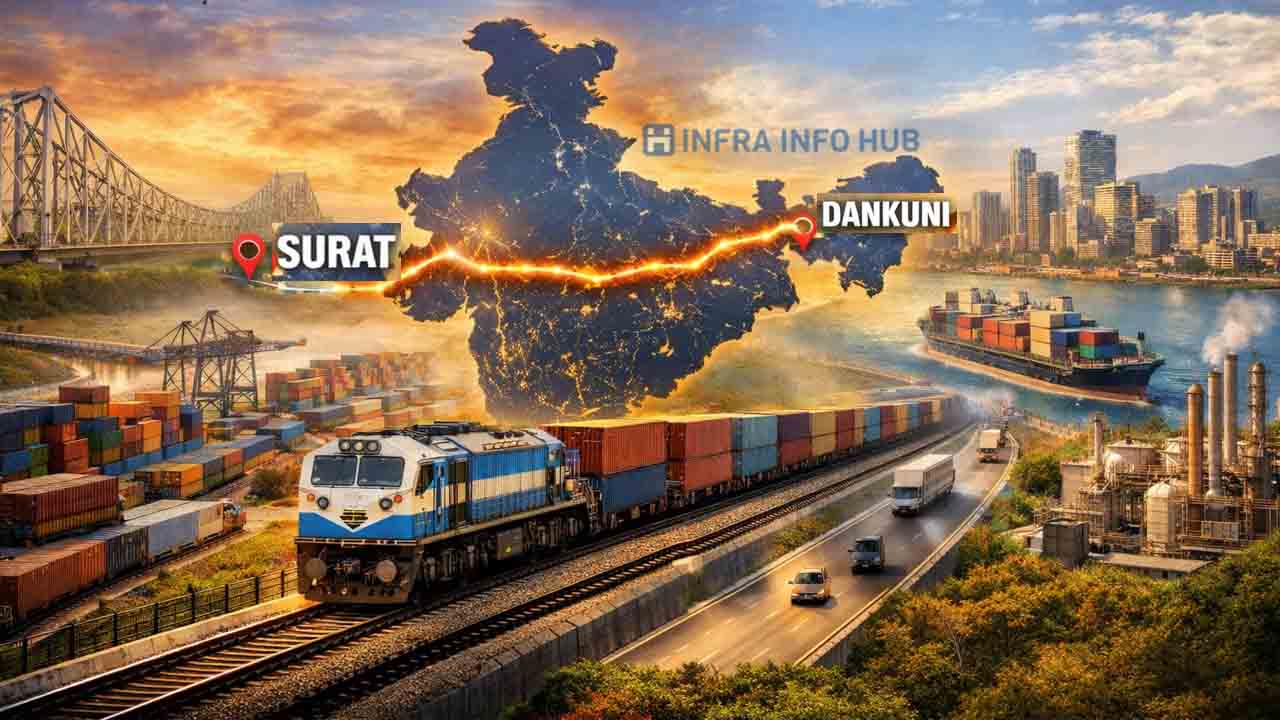
In a major boost to India’s infrastructure ambitions, Finance Minister Nirmala Sitharaman has announced a new Dedicated Freight Corridor (DFC) connecting Dankuni in West Bengal with Surat in Gujarat, during the presentation of the Union Budget 2026–27. This ambitious corridor is expected to become a game-changer for freight transportation across eastern and western India.
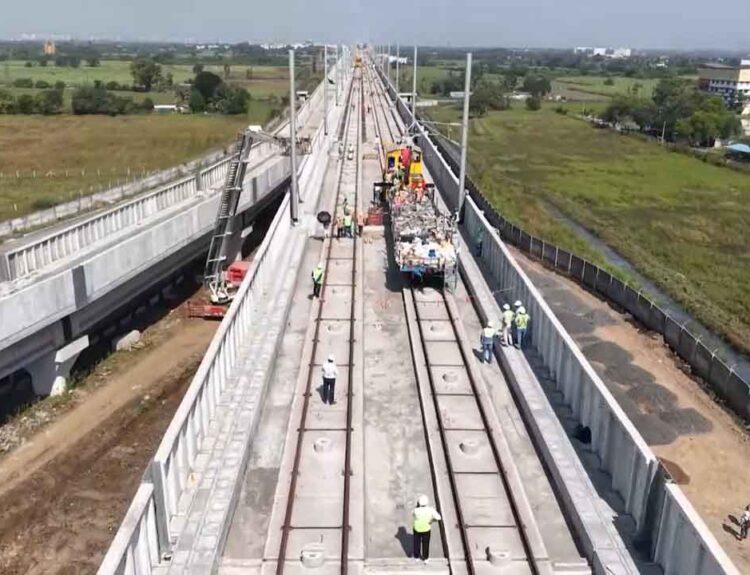
The proposed rail corridor will traverse multiple states, forming a high-capacity freight route that links major industrial, manufacturing, and consumption centres. Once operational, it is expected to significantly reduce logistics costs, improve delivery timelines, and ease pressure on the country’s congested passenger rail network.
At present, India operates two major dedicated freight corridors. The Eastern DFC runs from Ludhiana to Dankuni, while the Western DFC connects Dadri to Jawaharlal Nehru Port.
The newly announced Dankuni–Surat corridor will effectively bridge these two networks. By linking eastern and western freight routes, India will gain a continuous logistics spine stretching across northern and central regions. This integrated system is expected to streamline cargo movement from ports to factories, warehouses, and consumption hubs.
For businesses, this means faster transit times, fewer bottlenecks, and improved supply-chain reliability factors that are increasingly crucial in a competitive global market.
One of the biggest beneficiaries of the new corridor will be India’s manufacturing sector. Gujarat is home to major chemical, textile, engineering, and pharmaceutical clusters, while eastern India has strong bases in steel, coal, cement, and agro-processing.
By directly connecting these regions, the corridor will allow raw materials and finished goods to move more efficiently. This improved connectivity can lower production costs, attract new investments, and strengthen India’s position as a global manufacturing hub under the “Make in India” and “Atmanirbhar Bharat” initiatives.
Industrial parks, logistics hubs, and warehousing zones are also expected to develop along the corridor, creating new employment opportunities and stimulating regional development.
The announcement aligns closely with the National Logistics Policy, which aims to reduce India’s logistics costs from around 14–16 per cent of GDP to single-digit levels. High transportation costs have long been a challenge for Indian exporters and manufacturers, affecting price competitiveness in global markets.
Dedicated freight corridors are designed to address this issue by enabling high-speed, heavy-load trains with predictable schedules. With fewer stops and minimal interference from passenger services, freight trains can operate more efficiently and reliably.
The Dankuni–Surat DFC is expected to play a vital role in helping India achieve these long-term logistics targets.
Another important benefit of the new corridor will be the decongestion of existing railway lines. Currently, freight and passenger trains often share the same tracks, leading to delays and capacity constraints.
By shifting bulk cargo to dedicated routes, passenger services can operate more smoothly. This can translate into better punctuality, higher safety standards, and improved travel experiences for millions of daily commuters and long-distance passengers.
While the announcement has generated significant optimism, key details such as project cost, funding structure, alignment, and construction timeline are yet to be revealed. These aspects will determine how quickly the corridor can move from planning to execution.
Given India’s recent track record in completing large infrastructure projects, expectations are high that the government will fast-track approvals and implementation.
The Dankuni–Surat Dedicated Freight Corridor represents more than just a railway project. It reflects India’s broader shift towards infrastructure-led economic growth, integrated logistics planning, and long-term competitiveness.
If executed efficiently, this corridor could transform freight movement across the country, strengthen industrial ecosystems, and reinforce India’s position as a rising economic powerhouse. As more details emerge in the coming months, the project is likely to remain in focus for policymakers, investors, and industry leaders alike.